
Lesson plans
 Bala Janaagraha
 April 5, 2022
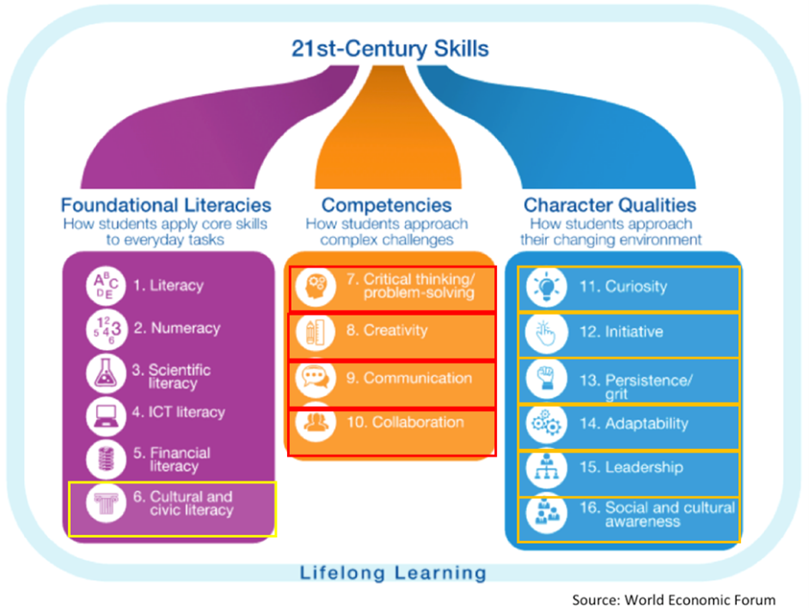
The education landscape in India is bound to undergo enormous changes in the next decade affecting 370 million children enrolled in over 15 lakh schools across the country today. By one popular estimate, 65% of children entering primary school today will ultimately end up working in completely new job types that don’t yet exist.
As part of the 21st century education provided to our children, the traditional academic system of learning will need to undergo a huge transformation to equip them with skills necessary for employment. They must be adept at skills such as collaboration, communication, problem-solving, leadership, emotional intelligence among others.
As most existing education systems, at the primary and secondary levels, provide highly siloed training with little acknowledgement of the preparation for the future, a relook at the existing systems becomes the imperative.
Taking cognisance of the future of education and gaps that exist in the current system, Janaagraha runs a Civic Learning program for students with the objective of ‘Every Child, An Active Citizen’.
The program design and construct has been planned to enable skills such as critical thinking and reasoning capacities, collaboration, multidisciplinary thinking, deliberation and bridge‐building among others. While the content promotes activity based and experiential learning, the civic project activity aims to make children think beyond symptoms and about root causes, engage with their local communities and feel empowered to be a change maker while also building in students critical skills for their future.
The Need for Aligned lesson plans
Systematic Civic Learning is an essential component of holistic education, preparing school students for life and work in a democracy. It is also a prerequisite for large-scale civic participation in our cities, whereby citizens take ownership of their neighbourhoods and cities and work constructively with each other and their governments to solve civic problems. Civic Learning therefore also strengthens the quality of democracy.
Therefore, it is important for students to undergo civics in schools in a more local context, in a practical manner and understand the importance of being an active citizen. Development of activity based lesson plans aligned to the curriculum would help in engaging students with experiential classroom sessions and reinforce learning in a fun filled way while also imbibing in students values of active citizenship.
What are Aligned lesson plans?
Aligned lesson plans are comprehensive content in form of PowerPoint and handbook.
Lesson plans are designed for certain chapters in civics for 6th–10th grades for NCERT and 6th – 8th graders for Sate board syllabus.
These lesson plans are interactive with a focus on pedagogy embedded with activities aligning to the concepts of the curriculum and added components of Active citizenship that help build certain behavior and attributes.
The lesson plans are aligned to the NCERT as well as State board hence acts as a great helping aid for teachers, thus making learning interesting and engaging for both teachers as well as students.
Why is Civic Learning important
Civic Learning, in the long run, has the potential to transform India’s cities and towns by creating a generation of change agents who are civically aware and engaged with their Government.
Children covered under the program will imbibe the following behaviours and attributes:
- Knowing and caring about rights and duties as citizens, both to the government and to each other.
- Treating all citizens as equal and not discriminating based on gender, race, language, caste, religion, ethnicity or other grounds.
- Participating actively in civic matters in the neighbourhood.
- Engaging constructively with local government officials, both elected and administrative, in addressing civic issues.
- Voting in all elections when eligible.
- Segregating waste, not littering.
- Respecting and obeying traffic rules.
- Conserving resources such as water, power in order to conserve and nurture the environment
- Being responsible in consumption habits, again to conserve the environment
- Taking care for and respecting public spaces, as common heritage o Not taking or offering any bribes.
- Knowing and following all other civic duties and obeying the rule of law.
The education and preparation of students to become informed and engaged citizens is essential for their empowerment and for the overall health of our democracy. Any democracy, worthy of that designation, must provide these opportunities in an equitable way. Civic learning done right also helps teach children skills they need for the 21st century workplace, such as critical thinking, problem solving, communication, collaboration, creativity, initiative and innovation.
Subscribe To Our Newsletter
Sign up for our newsletter to stay up to date with the latest in active citizenship and urban governance reforms in India’s cities and towns.